sre · incidents · verification · agents
Your pager is not your customer
On-call systems reward activity. A check that fatals on about a 60-second sample looks like diligence. It can also be a category error.
Sentry first saw a production synthetic health cron fatal-timing out on a Redis ping at 2026-08-12T17:08:08.393Z. That is first-seen, not a proven start-of-failure. A Sentinel packet collected on 2026-08-22T05:54Z–06:00Z (1:54–2:00 AM ET) still saw it firing, sampled about once a minute in that window. The documented slow-warn in that check is 2000ms. The abort that actually kills the probe is about 100ms. The ticket opened as P0 and sat in a backlog after the first hour.
We do not have proof a user felt it. So this is not an outage post. Recovery is not claimed. A later independent probe has not been run.
That is the useful part.
The trap
You write a slow-warn budget you believe in. A lower-level client cancels much sooner. The sampled cron fatals. The graph is honest about the abort and silent about the customer.
If abort is tighter than warn, the page is about your client policy, not customer impact, until you prove otherwise.
Four evidence states
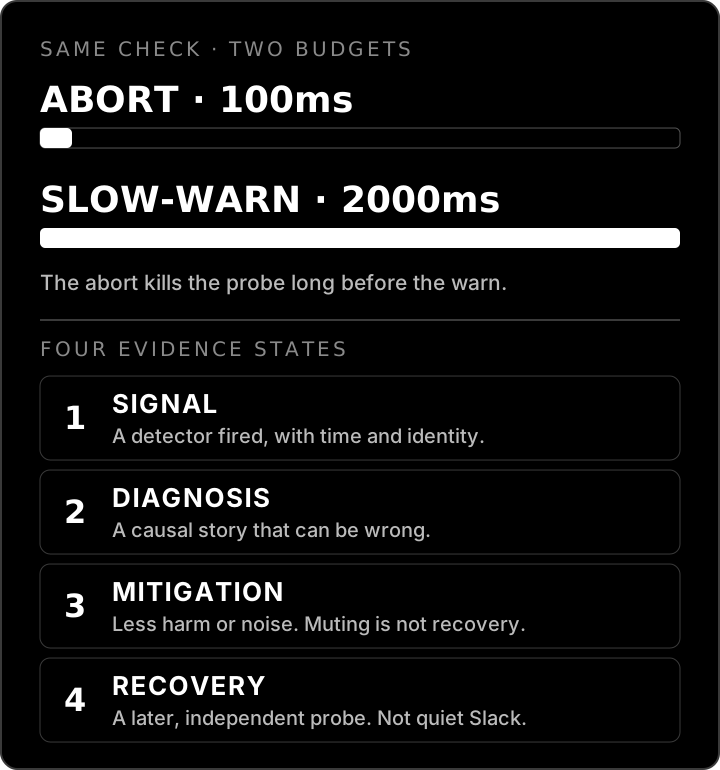
I want these on the incident template, not in a slide deck after the fact.
- Signal. A detector fired, with a time and an identity. That is a fact about a check.
- Diagnosis. A causal story that can be wrong.
- Mitigation. You reduced harm or noise without claiming the world is fixed. Muting a cron is mitigation. It is not recovery.
- Recovery. A second independent probe, later, that would have failed during the incident. The absence of the original exception is not this box.
Quiet Slack is not box 4.
What I refuse to say from this packet
- Users are down. (Unproven.)
- We recovered. (No second probe.)
- This is a customer-facing SEV because Sentry was loud.
- A P0 label from an auto-opened ticket is accepted severity.
- The cron “started” on 12 August. (That date is first-seen.)
The lesson is proposed, not a ratified architecture decision: a synthetic health check that fatals on a tighter timeout than its own slow-warn budget will page for days without proving customer impact. Recovery must be a second independent probe.
What to do Monday
Print the abort timeout next to the warn budget in the same file. If they disagree, write severity as unknown until a user-path probe exists that does not share that abort.
The homework is the check in your repo. Not a waitlist.