agent-memory · ranking · feedback-loops · retrieval
Your memory ranker is starving, not broken
Every importance score in your memory store is the same number. You have read the scoring formula twice and it is correct. You are about to add a fourth feature to it. Don't.
I ran into this on a memory engine I run for my own coding agents. A rescore pass put 1,780 of 1,782 memories at the minimum importance. The formula weighs repetition, explicit use, cross-session repeats and preference. It was right end to end: the only two memories above the floor were exactly the two that had ever received a use signal. Meanwhile the engine had served about 20,900 context packets to 376 agent sessions and heard back, in total, three times (three signals that landed on two memories). Serving was logged as "offered" and, by design, moved nothing.
That is a starved ranker: a scorer that works, fed almost nothing. This post is about telling a starved ranker from a broken one, and feeding it.
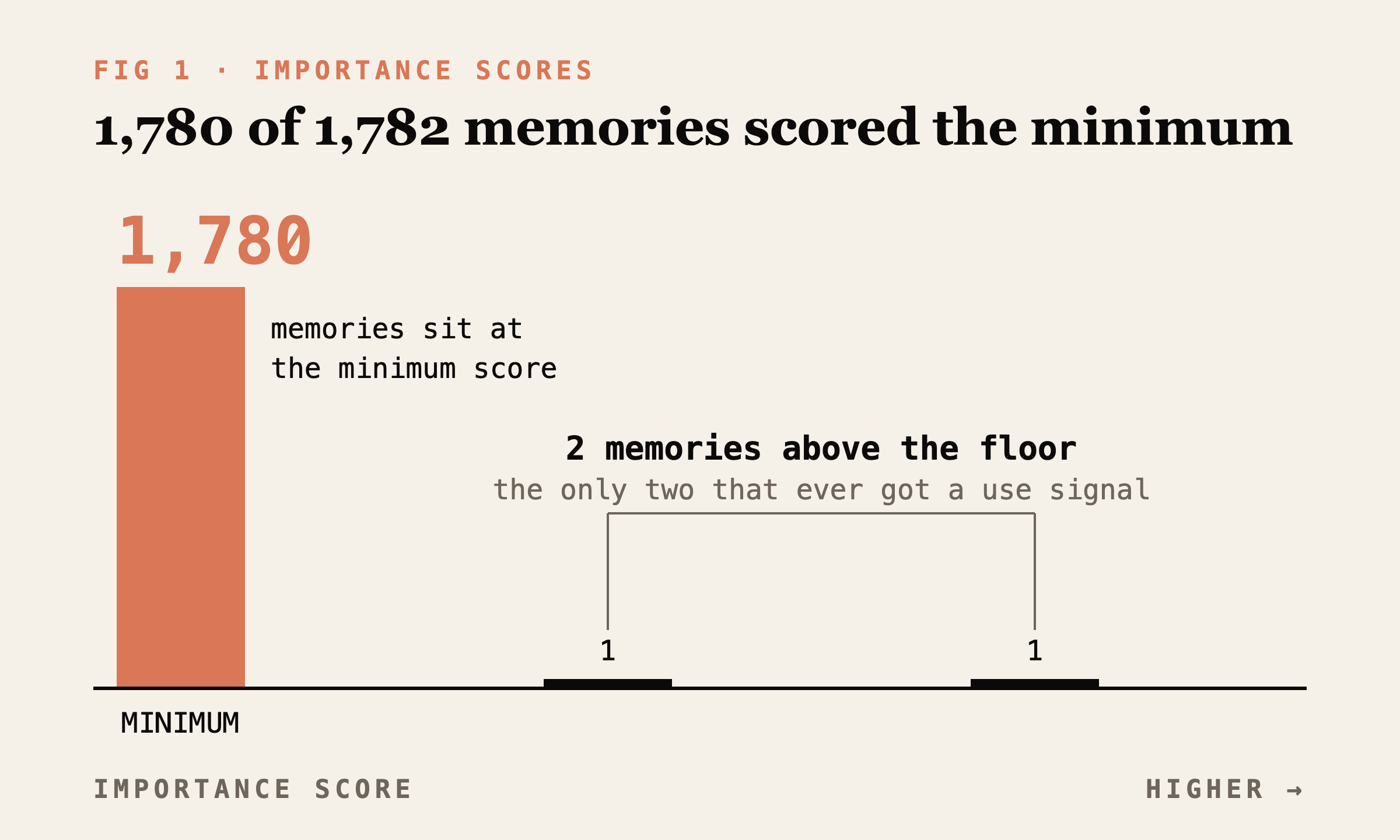
If your importance scores all sit at the floor, your ranker is not broken. It is starving.
Where ranking signals come from
Think of a library. The catalog can be flawless and the librarian brilliant, but if nobody records which books leave the building, every book looks equally unloved. A ranker is the librarian. It can only learn from what the agent tells it afterwards.
Trace the loop in your own system. Your engine serves a packet of memories. The agent acts on some of them and ignores the rest. A feedback path should carry that fact back as a row: either explicit ids from the agent, or an inference made by matching the agent's output against what it was shown. A rescore job reads those rows and moves scores. Ranking changes, and the next packet is a little better.
Many memory layers I have seen build every box in that diagram except the dashed edge. The serve path is thoroughly instrumented. The path that says "and the agent used this one" is a TODO, or a heuristic that fires once in a blue moon. The ranker keeps running on schedule and has nothing to chew on.
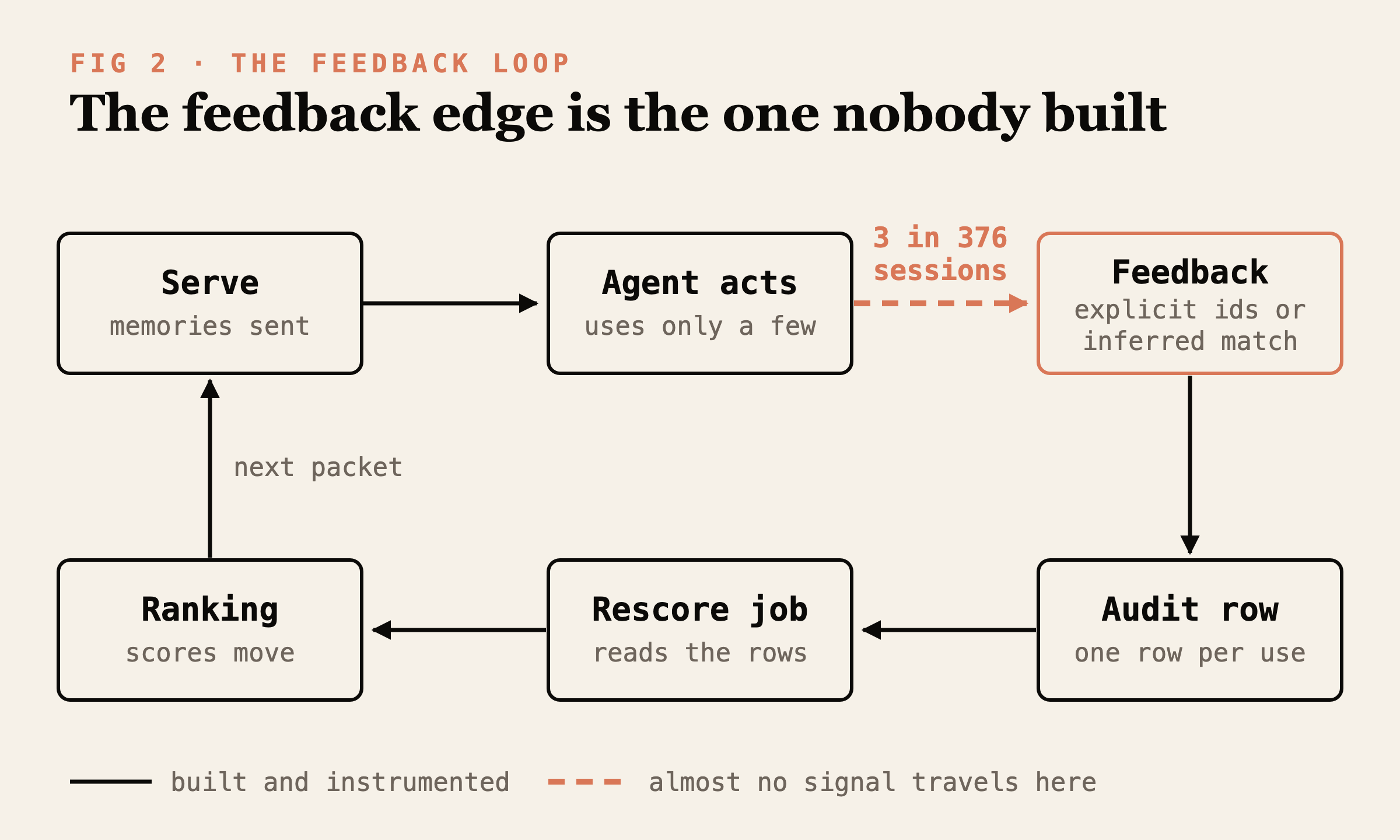
A ranker can only learn from what the agent tells it afterwards.
Offered is not used
The tempting shortcut is to count serves. You already have that data, it is dense, and the scores would finally spread out. Resist it.
Counting serves measures position, not value. Whatever ranked in the top few last week gets served this week, which earns it a higher score, which puts it in the top few next week. New facts never get a turn on the shelf. The ranker is grading its own homework, and it will give itself an A.
The library version: shelf views versus checkouts. A book on the front table gets looked at because it is on the front table. The only honest popularity signal is the one that required a person to carry the book out the door. Serves are shelf views. Uses are checkouts. Keep recording the serve, because you need it for the audit below, but give it zero weight in the score.
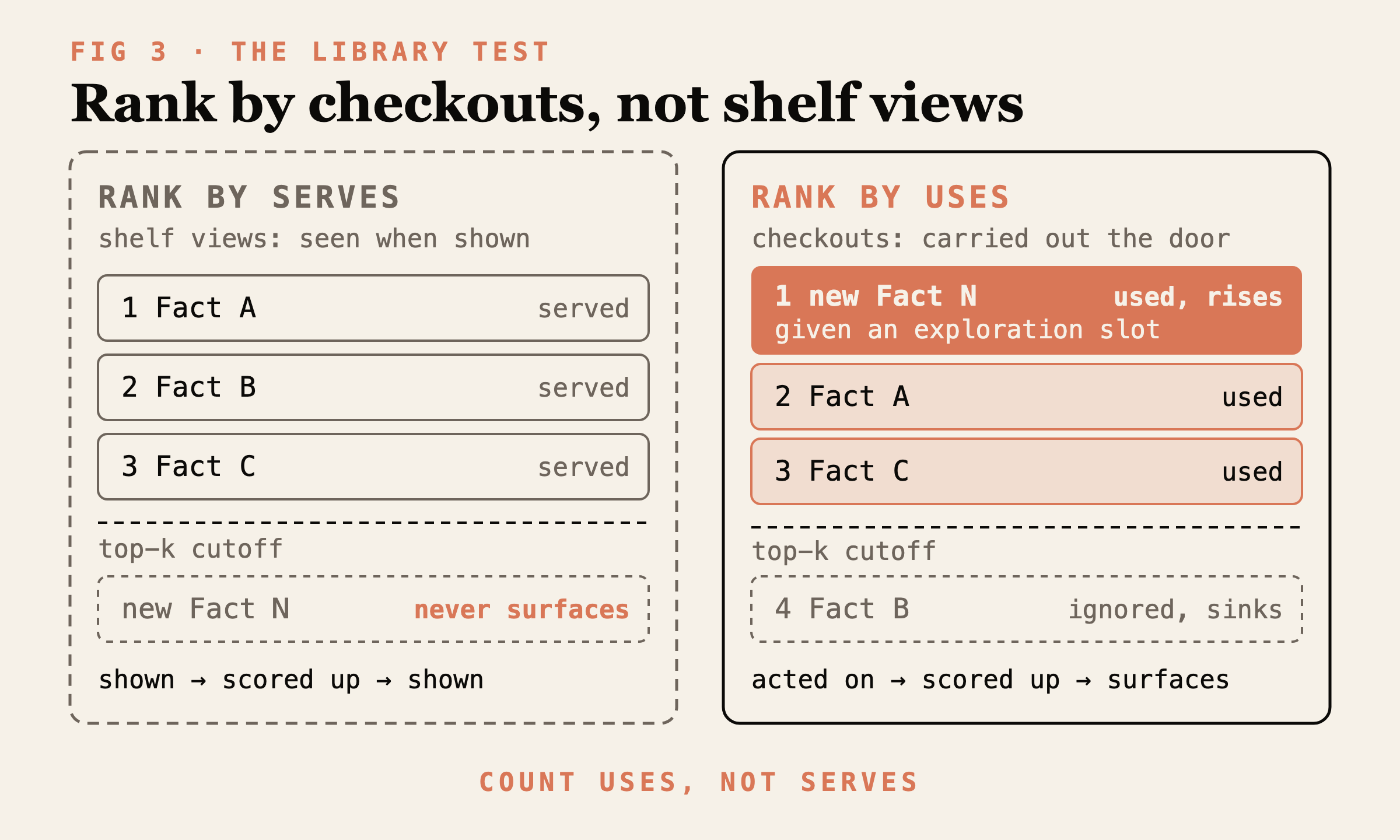
Count uses, not serves. Counting serves rewards position, not value; it makes the ranker grade its own homework.
The three-query audit
Before you touch the formula, run three queries. They assume three tables: memories(id, importance), served_packets(id, memory_ids[], session_id, served_at) and packet_feedback(packet_id, used_memory_ids[], kind, created_at). Rename to fit. The SQL is Postgres-flavored.
-- 1. Serves per memory: is the same top slice getting all the shelf time?
SELECT m.id, m.importance, count(*) AS serves
FROM memories m
JOIN served_packets p ON m.id = ANY (p.memory_ids)
GROUP BY m.id, m.importance
ORDER BY serves DESC
LIMIT 20;

-- 2. Packet-level uses per memory, next to serves: checkouts vs shelf views.
--    Diagnostic only: it counts packets, not sessions, so it is not a score.
--    'offered' rows are excluded on purpose.
SELECT m.id,
       count(DISTINCT p.id)                            AS serves,
       count(DISTINCT f.packet_id)                     AS uses,
       count(DISTINCT f.packet_id)::float
         / NULLIF(count(DISTINCT p.id), 0)             AS use_rate
FROM memories m
JOIN served_packets p      ON m.id = ANY (p.memory_ids)
LEFT JOIN packet_feedback f ON f.packet_id = p.id
                           AND m.id = ANY (f.used_memory_ids)
                           AND f.kind <> 'offered'
GROUP BY m.id
ORDER BY serves DESC
LIMIT 50;

-- 3. Starvation check: share of scores at the floor, and the share of
--    served packets that ever got a feedback row.
-- If your scorer has a fixed floor constant, replace the min() subquery with it.
SELECT
  count(*) FILTER (WHERE importance = (SELECT min(importance) FROM memories))::float
    / count(*)                                         AS share_at_floor,
  (SELECT count(DISTINCT packet_id) FROM packet_feedback WHERE kind <> 'offered')::float
    / NULLIF((SELECT count(*) FROM served_packets), 0) AS packets_with_feedback
FROM memories;
Read the results in this order. If share_at_floor is high and packets_with_feedback is near zero, you have a starved ranker and the formula is innocent. If feedback coverage is healthy but scores are still flat, now you may look at the formula. If query 1 shows the same twenty ids dominating while query 2 shows their use rate is low, you have position bias, which the failure modes below cover.
Run these before you touch the formula.
Feed the ranker: four moves
You do not need a research project. You need four moves, in this order of trust.
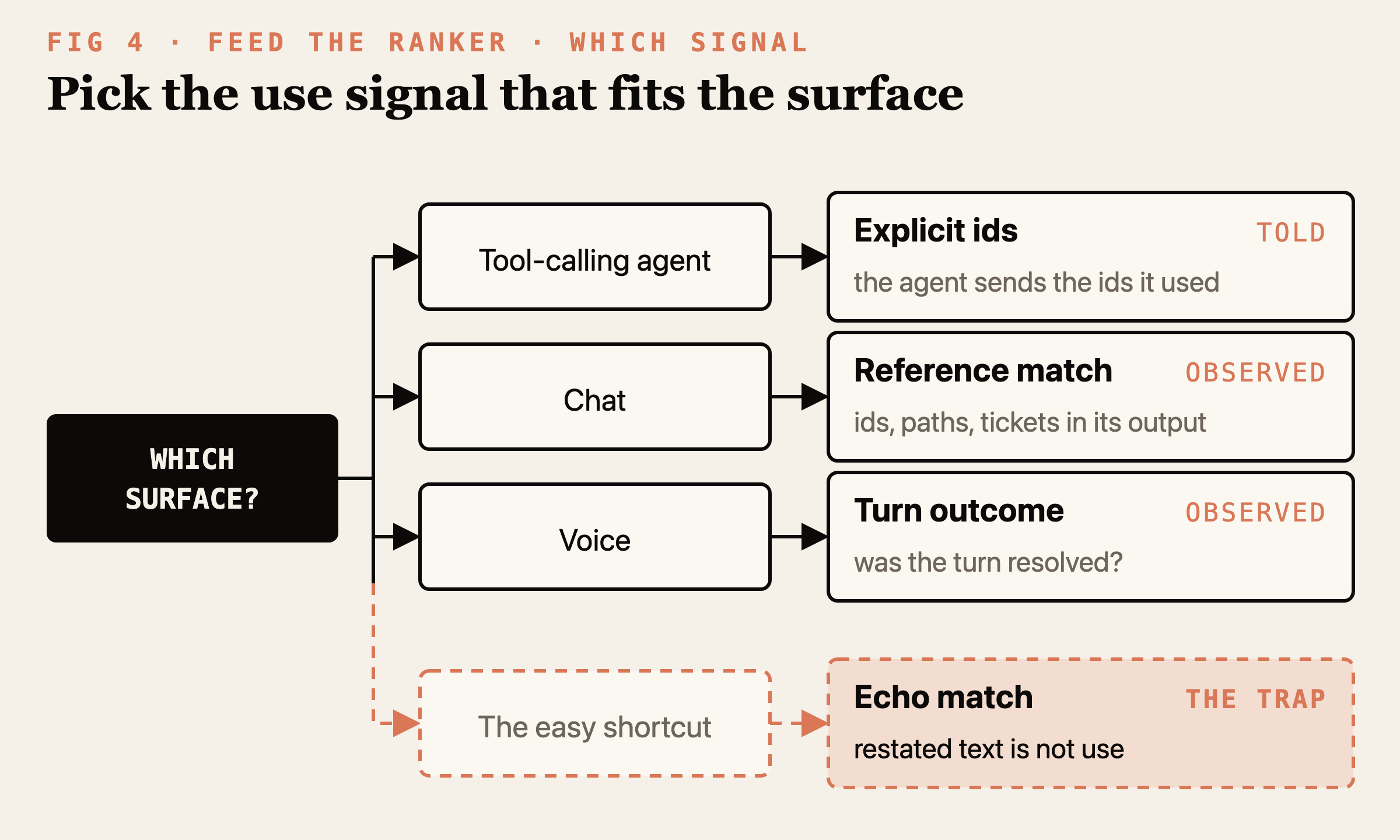
1. Explicit ids from the agent. Give the agent a tool, or a field on its existing tool, that says "I used these memories." This is the strongest signal and the cheapest to reason about. Where your agent calls tools, this is the default.
2. Inferred use by reference match. Where the agent will not report, infer from what it produced. Look for the concrete handles a memory carries: ticket ids, file paths, function names, entity names, quoted values. If the agent's output or tool calls reference a handle from a served memory, count it as a use. This is a checkout you observed rather than one you were told about.
Voice and other surfaces with no text output. A resolved turn tells you the packet helped, not which memory did. Record it as a weak packet-level signal, separate from memory use, and credit a specific memory only when the turn carries one of its handles (an order number, a name, a date it stated). Crediting every served memory for a good turn brings position bias straight back.
3. Cross-session repeats. A memory used once in each of fifty sessions says more than a memory used fifty times in one session. Score on distinct sessions, so one long conversation cannot crown a fact: count the sessions in which a memory was used, divided by the sessions in which it was served. Query 2's packet-level rate is a diagnostic, not this score. Reserve one or two slots per packet for low-exposure memories so new facts get a turn. A fact that is never served can never be used, which is the same cold-start trap serves create.
4. A cheap, reversible rescore. Recompute from the feedback rows on a schedule. Keep the previous score beside the new one, cap how far a score can move per run, and make the job dry-run by default so you can diff before you commit. If a run looks wrong, restoring last run's scores is one statement.
One trap to avoid on the way: the echo match. It checks whether the agent repeated the memory's text back, and it looks like reference matching, but it is not. Echo matching is counting the people who read a spine aloud and calling them borrowers. Agents act on facts without restating them, and they restate facts they never needed. On my engine an echo heuristic was the only source of signal, and it barely registered. If echo is all you have, plan as if you have no signal.
Which signal fits depends on the surface:
Here is the smallest payload an agent tool needs to send. Nothing else is required to start. The packet_id comes back in the serve response; the agent just echoes it with the ids it used.
{
  "packet_id": "pkt_8f3a",
  "kind": "explicit",
  "used_memory_ids": ["mem_42", "mem_77"]
}
Explicit beats inferred; inferred by reference beats inferred by echo; rescore cheaply and reversibly.
What to expect, and the three ways it stalls
This is the shape I would expect, not a measured result, so read the days as illustrative. Once signals flow, the floor should lift quickly because the first feedback rows touch exactly the memories that were doing the work. A first spread appears within days. Within a week, the top of your ranking should be a list a human recognises as "yes, those are the facts we keep needing." Day zero is the flat floor you started with.
A starved ranker stays starved in three ways.
- Starvation continues. You wired the path but coverage is still tiny: the tool is never called, or only on one surface. Query 3 tells you.
- Position bias returns. You slipped serves back into the score, or your feedback only fires for memories that were already first in line. Query 1 against query 2 tells you.
- Stale caches. You rescored, but packets are cached by query and served for hours or days, so the new ranking never reaches the agent. Key the cache on a score version, or expire it when a rescore lands.
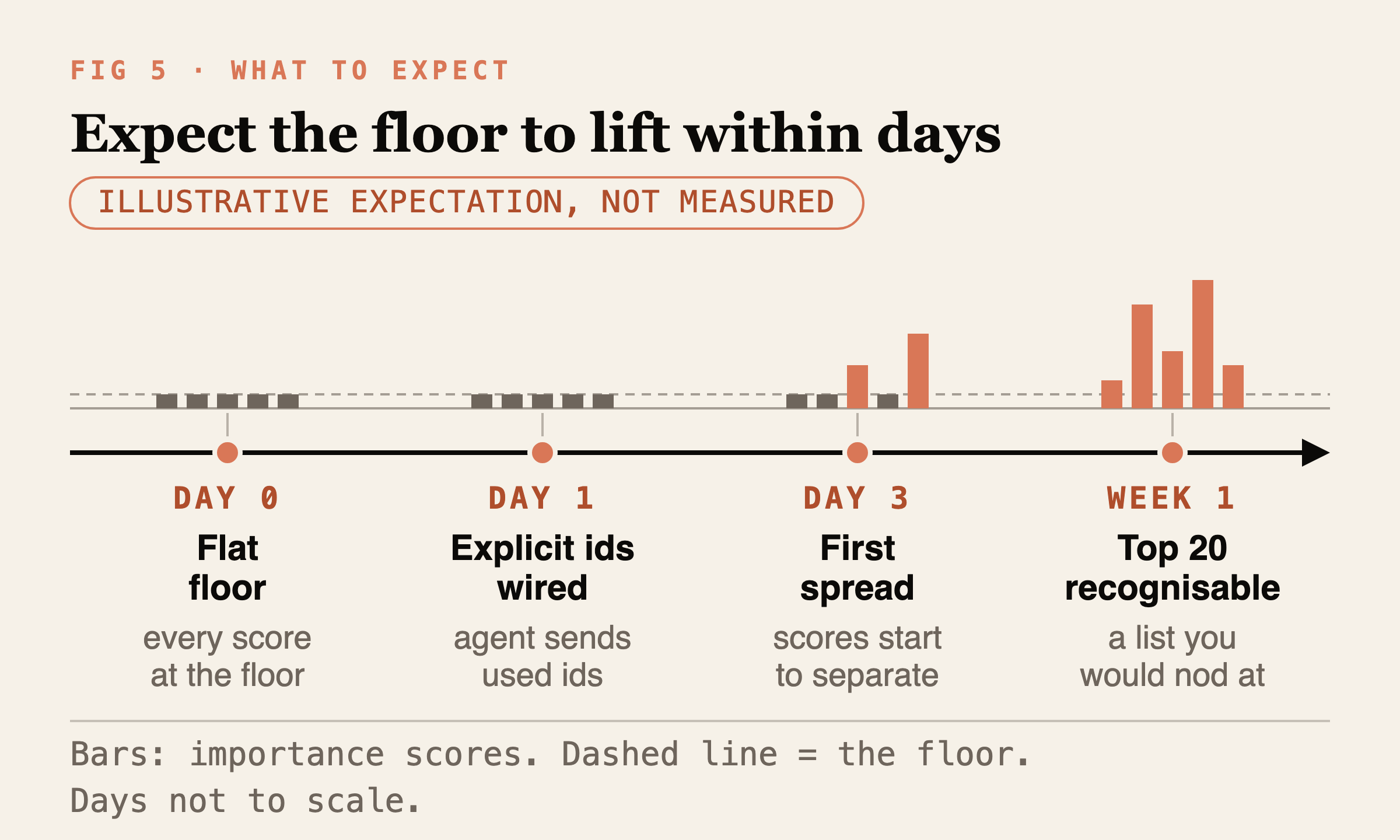
Once signals flow, the floor should lift within days; starvation, position bias and stale caches are the three ways it stalls.
The checklist
Copy this into your tracker.
- Log every serve as "offered", and give it zero weight in the score.
- Run the three audit queries and record your floor share and feedback coverage.
- Add a way for the agent to report used memory ids, and make it the default path.
- For agents that will not report, infer use by reference match on ids, paths and tickets.
- Delete any echo-match heuristic from the score, or demote it to a weak tie-breaker.
- Score on use rate across distinct sessions, not raw counts, and reserve a slot or two per packet for under-served memories.
- Keep the prior score, cap per-run movement, and run the job dry-run first.
- Version the packet cache by score, and re-run query 3 weekly.
If you remember one line, make it this one: count uses, not serves.
Which signal does your agent send back today: none, echo, or ids?